Blog · Oct 26, 2026 · By Velocity11
Small businesses aren't firing people for AI. They're just not hiring.

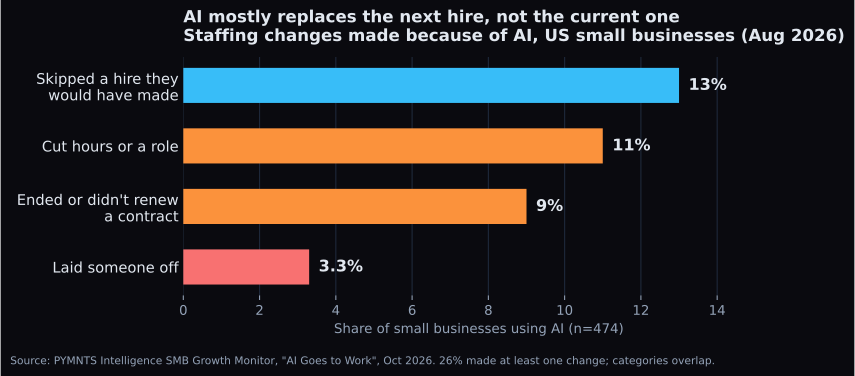
The scary story about AI and jobs is a firing story. New data from 533 US small businesses tells a quieter one. Only 3.3% of businesses that use AI have laid anyone off because of it. But 13% have skipped a hire they otherwise would have made - about four times as many. AI at small businesses mostly does not replace the person at the desk. It replaces the empty chair you were about to fill. [1]
The survey
PYMNTS Intelligence surveyed 533 small and medium businesses across the US in August 2026, weighted to reflect the country's small business population (all of them have a physical location). Most have tried AI: 88% have used it, 74% use it at least occasionally, and 44% use it frequently. [1]
What AI actually changed about hiring
One in four businesses using AI (26%) has made at least one staffing change because of it. The most common: skipping a hire (13%). Then cutting hours or a role (11%), ending or not renewing a contract (9%), and - far behind - laying someone off (3.3%). Three-quarters of AI-using businesses made none of these changes. The roles most often not hired: full-time employees (13%) and freelancers (12%). [1]
Does it pay?
On average, yes - with honest caveats. Businesses estimating both sides reported average savings equal to 10% of annual revenue from doing work with AI instead of paying for help, against losses of 4.7% from customers using AI instead of hiring them. The most frequent users report the biggest gains (16% of revenue saved) and also the biggest losses (about 7%). Speed is the top benefit: 72% of users say they finish work faster, 64% say it helps them compete, and 6 in 10 produce more work without adding staff. But 28% say their AI spending exceeded expectations, and 22% have done extra work fixing AI errors. Faster is not automatically cheaper. [1]
The habit gap
The most interesting split is not who has AI - nearly everyone has tried it. It is who uses it regularly. Among businesses whose revenue grew in 2025, 57% use AI frequently, nearly double the 29% among flat businesses. And 68% of frequent users grew revenue last year, versus 37% of rare users. The researchers are explicit: this is a connection, not proof that AI caused the growth. Growing businesses may simply have the slack to build the habit. But either way, the divider is routine use, not access. [1]
Human is now a product
The surprise twist: customers' own AI use is creating work. Nearly one-quarter of small businesses (23%) say they gained customers who specifically wanted a person doing the work. 14% now get paid to fix AI-generated output - customers made something with AI, hit its limits, and hired a human to repair it. One in five businesses (21%) already emphasizes the human touch in its marketing or plans to. [1]
Fair warnings
- This is one survey of 533 US businesses, self-reported. The savings and loss figures are owners' estimates from answer ranges, not audited numbers - and 27% of users report no financial impact from AI at all so far. [1]
- The revenue-growth link runs both ways: the study says plainly that it shows a connection, not causation. [1]
- "Skipped a hire" is a decision nobody can fully verify - the owner believes they would have hired. It is still the clearest window into how AI changes small-business staffing: quietly, and before the job ever exists. [1]
What to do with this
- Make one task a daily habit. The data keeps pointing at regular use, not dabbling, as the divider. Pick the chore you repeat most - quotes, replies, bookkeeping - and run it with AI every day for a month.
- Price your overspend. Nearly 3 in 10 users spent more on AI than expected. Subscriptions plus fixing errors is the real cost; count both before you count the savings.
- Sell the human part. If customers can get the AI version free, the person behind your work is the premium. Say so out loud - 23% of businesses already win customers that way.
Try it this week
List the three tasks you would hand to your next hire. Do one of them with AI every day this week, start to finish, and time it. That is the experiment the 13% ran before they took down the Help Wanted sign.
We use AI to help write these posts, and we say so on every one: this post was written with AI help and reviewed by a person.
Has AI replaced a hire at your business - or created work you didn't expect? Tell us on Instagram @velocity11ai.
Source
[1] PYMNTS Intelligence, "AI Goes to Work: How SMBs Grow Without Growing Payroll", SMB Growth Monitor, Oct 2026 (survey of 533 US SMBs, Aug 2026). pymnts.com/report/study/ai-goes-to-work-how-smbs-grow-without-growing-payroll
The hero image was made with AI. The chart was drawn by Velocity11 from the published numbers. This post was written with AI help and reviewed by a person.