Blog · Oct 9, 2026 · By Velocity11
Will AI make us think less? What the surveys say, and a 3-step habit
Here is a worry you do not hear in the job debate. It is not "will AI take my work". It is "will AI make me lazy".
We looked at two sources: a large public opinion survey, and a smaller study of people who use AI at work every week. They point the same way, and they also disagree in a useful place.
Part 1: What people expect (Pew survey)
In a 2025 Pew Research survey, 53% of US adults said AI will make people worse at thinking creatively. Only 16% said better, and 16% said no change. [1]
On forming meaningful relationships, 50% said worse and 5% said better. On problem-solving the split was softer: 38% said worse, 29% said better. [1]
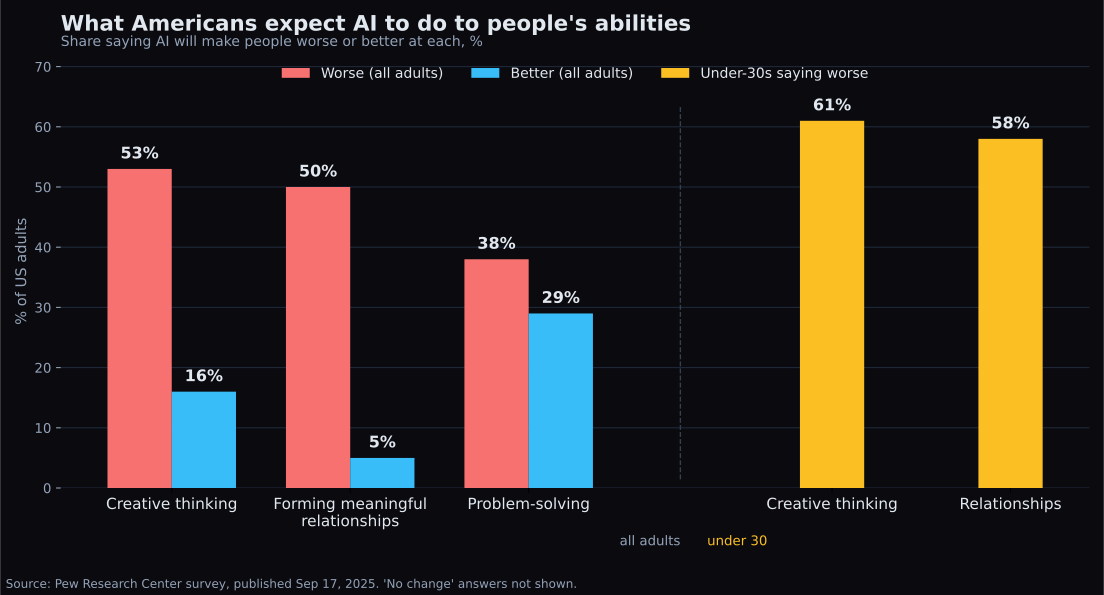
Young adults were more worried, not less. Among under-30s, 61% said worse for creative thinking and 58% said worse for relationships. About four in ten adults 65 and older said the same. [1]
People want control, not a ban
About six in ten said they want more control over how AI is used. 76% said it is very or extremely important to tell whether text, pictures or video came from AI or a person, but 53% are not confident they could tell. Nearly three quarters would let AI help at least a little with daily tasks. [1]
So the message is not "no AI". It is "AI, but let me stay in charge".
Part 2: What people who use AI at work report (Microsoft and Carnegie Mellon)
In 2025, researchers surveyed 319 knowledge workers who shared 936 real examples of using generative AI at work. [2]
Their main finding: people who had more confidence in the AI reported less critical thinking. People with more confidence in their own skills reported more critical thinking. [2]
They also found that AI changes what thinking looks like. It moves from doing the work yourself toward checking the AI's answer, fitting it into your work, and steering the task. [2]
Read that carefully. This is self-reported, from a survey. It does not prove AI makes anyone's brain weaker. It does suggest the risk is not the tool, it is trusting it without checking.
Is the fear true?
Honest answer: the surveys show what people expect and what they say they do. We did not find proof in these sources that AI makes people think less in the long run. It is a fair worry, not a proven fact, and the habit you build matters more than the tool.
A 3-step habit to keep your thinking sharp
- Think first. Write your own rough idea or outline, then ask AI to improve it. Not the other way around.
- Check the answer. Pick one claim in every AI answer and verify it. This is the "checking" skill the study describes.
- Ask it to argue against you. It is good at that, and you have to think harder to answer.
Bonus: one thing a week with no AI at all. Notice how it feels.
Try it today
Take one task you would normally hand to AI, like an email or a plan. Do step 1 and step 2 above. It adds about five minutes.
We use AI to help write these posts, and we say so on every one: this post was written with AI help and reviewed by a person.
Do you think AI makes people think less? Tell us on Instagram @velocity11ai.
Sources
[1] Pew Research Center, "How Americans View AI and Its Impact on People and Society", Sep 17, 2025. pewresearch.org
[2] Lee et al., "The Impact of Generative AI on Critical Thinking: Self-Reported Reductions in Cognitive Effort and Confidence Effects From a Survey of Knowledge Workers", CHI 2025. microsoft.com
The hero image was made with AI. The chart was drawn by Velocity11 from the published Pew numbers. This post was written with AI help and reviewed by a person.